

The Drawing Below Represents The Unit Cell For Which Crystal Structure?
12.two: The Arrangement of Atoms in Crystalline Solids
- Page ID
- 6403
Learning Objectives
- To recognize the unit cell of a crystalline solid.
- To calculate the density of a solid given its unit of measurement cell.
Because a crystalline solid consists of repeating patterns of its components in three dimensions (a crystal lattice), we can represent the entire crystal by drawing the structure of the smallest identical units that, when stacked together, form the crystal. This basic repeating unit is called a unit cell. For instance, the unit jail cell of a sheet of identical postage stamps is a single stamp, and the unit of measurement cell of a stack of bricks is a single brick. In this section, we draw the arrangements of atoms in various unit cells.
Unit cells are easiest to visualize in ii dimensions. In many cases, more than i unit jail cell tin can be used to correspond a given structure, as shown for the Escher drawing in the affiliate opener and for a two-dimensional crystal lattice in Figure 12.ii. Usually the smallest unit prison cell that completely describes the lodge is chosen. The simply requirement for a valid unit cell is that repeating it in space must produce the regular lattice. Thus the unit jail cell in part (d) in Figure 12.2 is not a valid choice because repeating it in infinite does not produce the desired lattice (there are triangular holes). The concept of unit cells is extended to a iii-dimensional lattice in the schematic drawing in Figure 12.3.
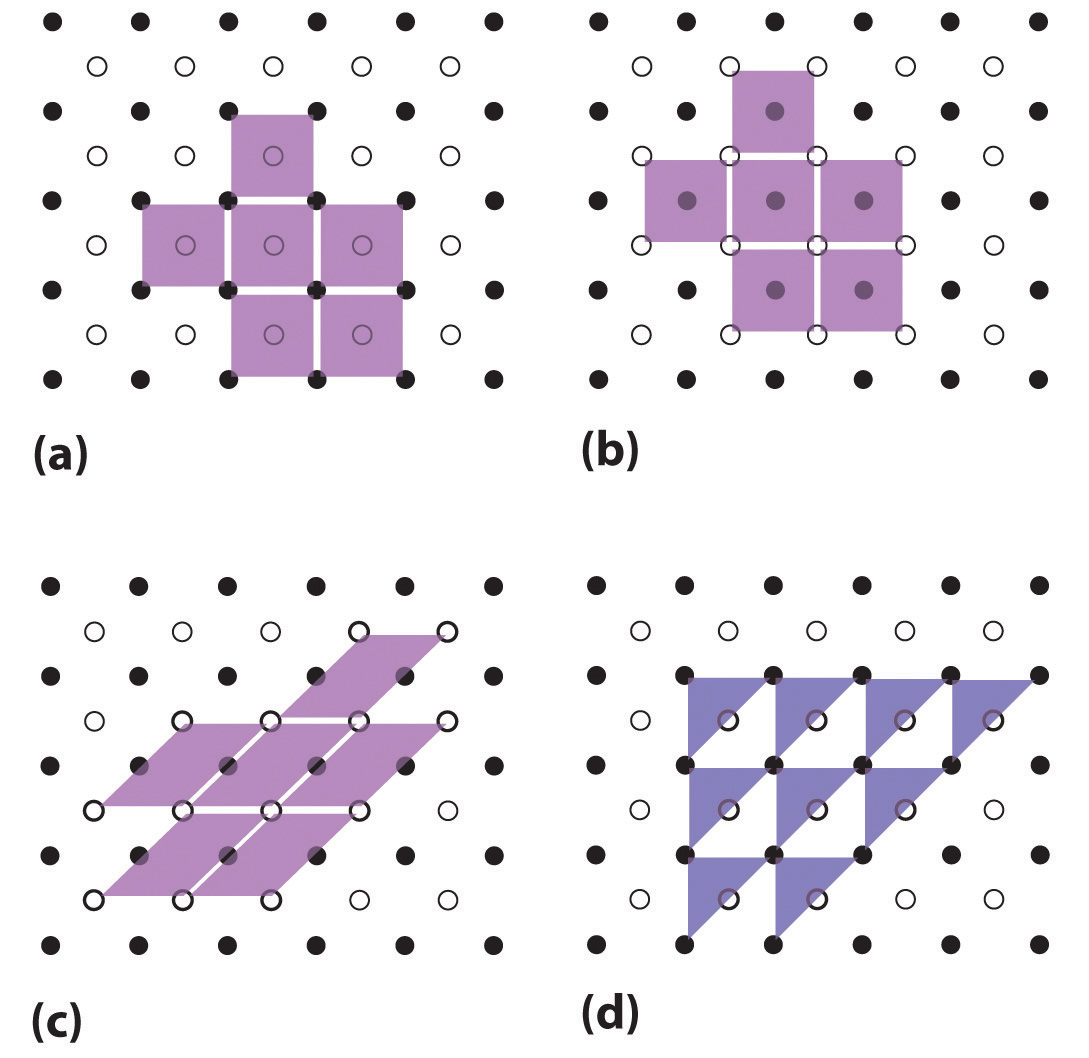
Figure 12.2 Unit Cells in Ii Dimensions. (a–c) Iii ii-dimensional lattices illustrate the possible choices of the unit cell. The unit of measurement cells differ in their relative locations or orientations inside the lattice, just they are all valid choices because repeating them in whatsoever direction fills the overall design of dots. (d) The triangle is non a valid unit cell because repeating information technology in space fills only half of the space in the pattern. (CC BY-NC-SA; bearding by request)
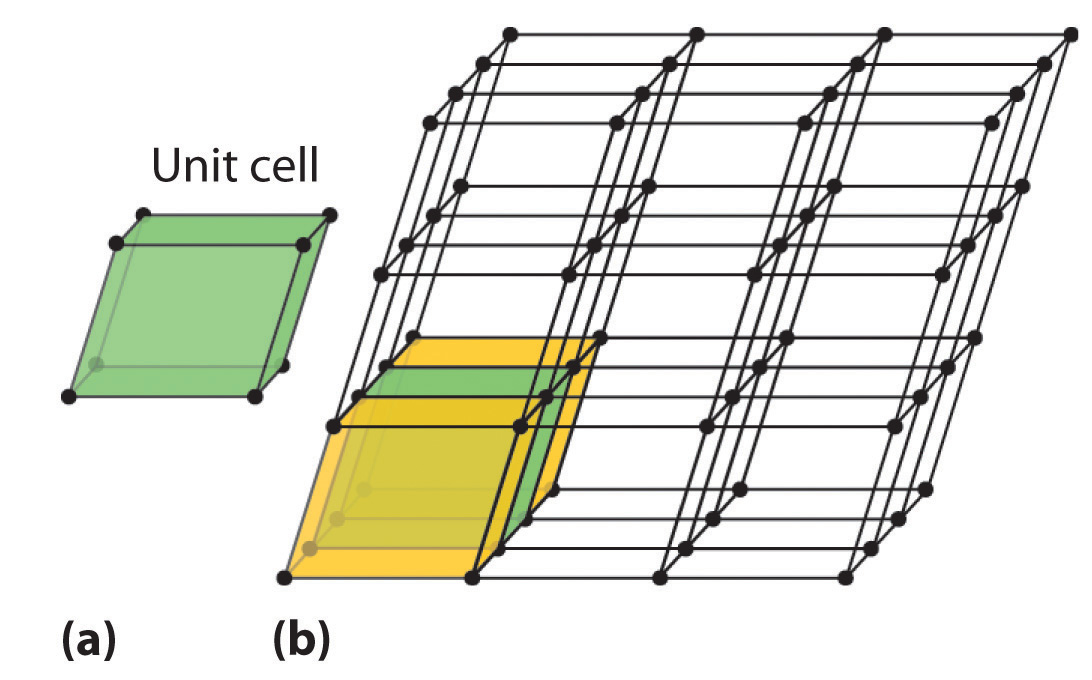
Figure 12.3 Unit Cells in 3 Dimensions. These images show (a) a three-dimensional unit cell and (b) the resulting regular three-dimensional lattice. (CC Past-NC-SA; anonymous by asking)
The Unit of measurement Prison cell
At that place are vii fundamentally different kinds of unit cells, which differ in the relative lengths of the edges and the angles between them (Figure 12.four). Each unit cell has six sides, and each side is a parallelogram. We focus primarily on the cubic unit cells, in which all sides have the same length and all angles are 90°, only the concepts that we introduce also apply to substances whose unit of measurement cells are not cubic.
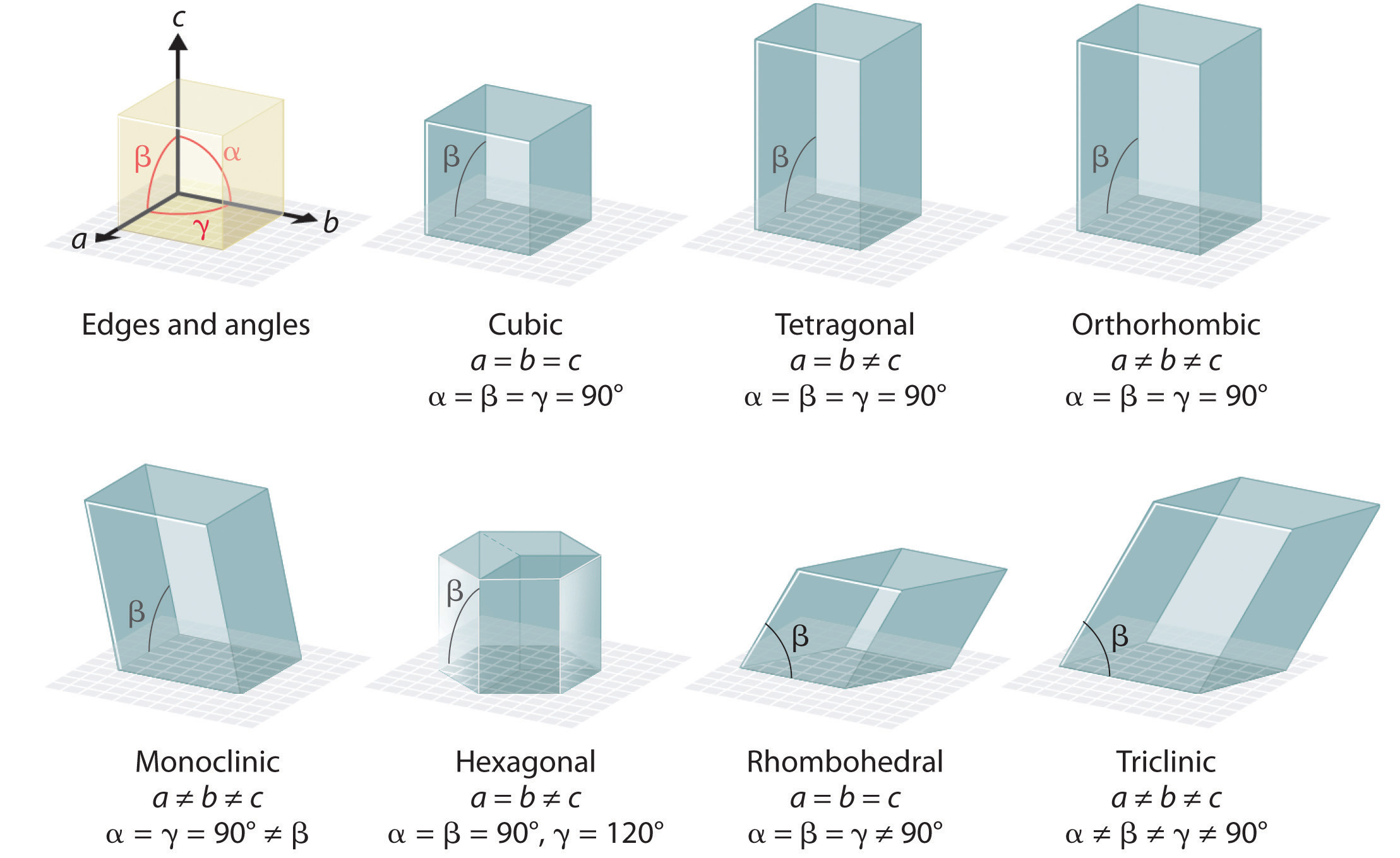
Figure 12.4 The General Features of the Seven Basic Unit Cells. The lengths of the edges of the unit of measurement cells are indicated by a, b, and c, and the angles are divers every bit follows: α, the angle between b and c; β, the angle between a and c; and γ, the angle betwixt a and b. (CC Past-NC-SA; bearding by asking)
If the cubic unit prison cell consists of eight component atoms, molecules, or ions located at the corners of the cube, so it is called simple cubic (part (a) in Figure 12.5). If the unit cell also contains an identical component in the centre of the cube, and so it is body-centered cubic (bcc) (function (b) in Figure 12.five). If in that location are components in the center of each face in improver to those at the corners of the cube, then the unit prison cell is confront-centered cubic (fcc) (function (c) in Figure 12.5).
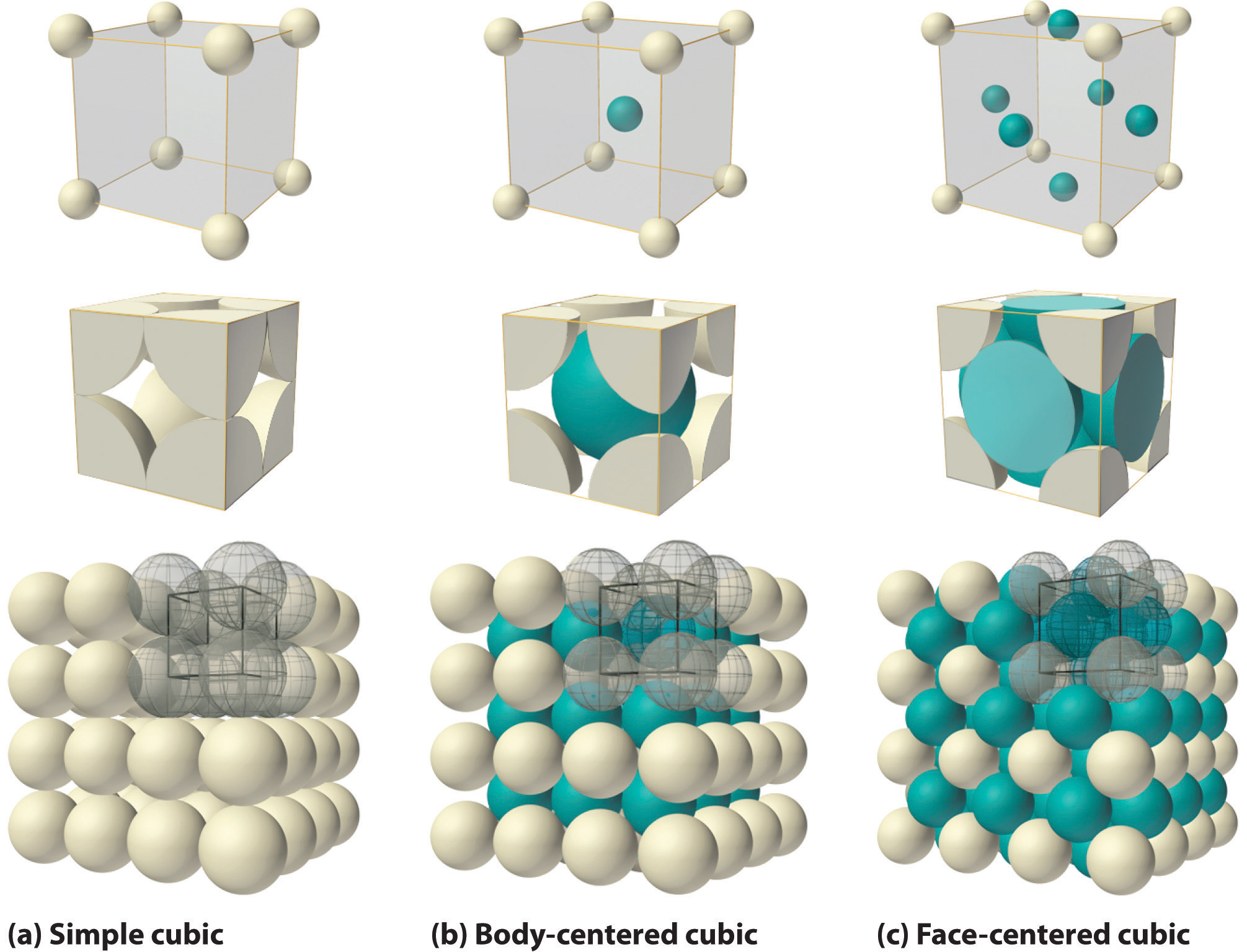
Effigy 12.v The 3 Kinds of Cubic Unit of measurement Prison cell. For the 3 kinds of cubic unit of measurement cells, simple cubic (a), body-centered cubic (b), and confront-centered cubic (c), at that place are 3 representations for each: a brawl-and-stick model, a infinite-filling cutaway model that shows the portion of each atom that lies within the unit cell, and an aggregate of several unit cells. (CC By-NC-SA; anonymous past request)
As indicated in Figure 12.5, a solid consists of a large number of unit cells arrayed in three dimensions. Whatsoever intensive property of the bulk material, such as its density, must therefore also be related to its unit cell. Because density is the mass of substance per unit of measurement book, we tin can calculate the density of the bulk material from the density of a single unit cell. To do this, nosotros need to know the size of the unit cell (to obtain its volume), the molar mass of its components, and the number of components per unit of measurement cell. When nosotros count atoms or ions in a unit of measurement cell, notwithstanding, those lying on a confront, an edge, or a corner contribute to more than than one unit cell, as shown in Figure 12.5. For example, an atom that lies on a face of a unit of measurement cell is shared by ii adjacent unit cells and is therefore counted as 12 atom per unit prison cell. Similarly, an atom that lies on the edge of a unit prison cell is shared past four next unit cells, so it contributes 14 atom to each. An atom at a corner of a unit cell is shared by all 8 side by side unit cells and therefore contributes 18 cantlet to each.The statement that atoms lying on an edge or a corner of a unit cell count as fourteen or 18 atom per unit of measurement cell, respectively, is true for all unit of measurement cells except the hexagonal i, in which three unit cells share each vertical edge and six share each corner (Figure 12.four), leading to values of 13 and sixteen atom per unit cell, respectively, for atoms in these positions. In contrast, atoms that prevarication entirely within a unit of measurement prison cell, such equally the atom in the center of a body-centered cubic unit cell, belong to but that one unit prison cell.
| Annotation |
|---|
| For all unit cells except hexagonal, atoms on the faces contribute \({1\over 2}\) atom to each unit of measurement cell, atoms on the edges contribute \({i \over 4}\) atom to each unit cell, and atoms on the corners contribute \({1 \over 8}\) atom to each unit cell. |
| Example 1 |
|---|
| Metal golden has a face up-centered cubic unit prison cell (function (c) in Figure 12.five). How many Au atoms are in each unit of measurement prison cell? Given: unit jail cell Asked for: number of atoms per unit of measurement cell Strategy: Using Figure 12.5, identify the positions of the Au atoms in a confront-centered cubic unit of measurement cell and and so make up one's mind how much each Au atom contributes to the unit jail cell. Add the contributions of all the Au atoms to obtain the total number of Au atoms in a unit cell. Solution: Every bit shown in Figure 12.5, a face up-centered cubic unit of measurement jail cell has eight atoms at the corners of the cube and vi atoms on the faces. Considering atoms on a confront are shared past two unit cells, each counts as \({1 \over 2}\) atom per unit of measurement cell, giving 6×\({1 \over 2}\)=three Au atoms per unit of measurement cell. Atoms on a corner are shared by eight unit cells and hence contribute simply \({one \over 8}\) atom per unit cell, giving 8×\({1 \over 8}\) =i Au atom per unit prison cell. The total number of Au atoms in each unit prison cell is thus 3 + i = 4. |
| Practise ane |
|---|
| Metallic iron has a body-centered cubic unit cell (role (b) in Effigy 12.5). How many Fe atoms are in each unit of measurement jail cell? Answer: two |
Now that we know how to count atoms in unit cells, we can use unit cells to calculate the densities of simple compounds. Notation, however, that we are assuming a solid consists of a perfect regular array of unit cells, whereas existent substances contain impurities and defects that bear upon many of their bulk properties, including density. Consequently, the results of our calculations will exist close but not necessarily identical to the experimentally obtained values.
| Example 2 |
|---|
| Calculate the density of metallic iron, which has a torso-centered cubic unit cell (part (b) in Effigy 12.five) with an edge length of 286.6 pm. Given: unit cell and border length Asked for: density Strategy:
Solution: A We know from Example one that each unit jail cell of metallic iron contains two Fe atoms. B The molar mass of iron is 55.85 g/mol. Because density is mass per unit of measurement volume, we demand to calculate the mass of the iron atoms in the unit of measurement prison cell from the molar mass and Avogadro's number and then divide the mass past the volume of the cell (making sure to use suitable units to get density in g/cmiii): \[ mass \; of \; Iron=\left ( 2 \; \cancel{atoms} \; Iron \right )\left ( \dfrac{ 1 \; \abolish{mol}}{half-dozen.022\times ten^{23} \; \abolish{atoms}} \correct )\left ( \dfrac{55.85 \; grand}{\cancel{mol}} \correct ) =1.855\times ten^{-22} \; yard \] \[ book=\left [ \left ( 286.6 \; pm \right )\left ( \dfrac{10^{-12 }\; \abolish{m}}{\cancel{pm}} \correct )\left ( \dfrac{10^{2} \; cm}{\abolish{m}} \correct ) \right ] =two.345\times 10^{-23} \; cm^{3} \] \[ density = \dfrac{1.855\times x^{-22} \; g}{ii.345\times 10^{-23} \; cm^{iii}} = seven.880 g/cm^{3} \] This result compares well with the tabulated experimental value of 7.874 g/cmiii. |
| Practice |
|---|
| Calculate the density of gold, which has a confront-centered cubic unit cell (part (c) in Effigy 12.v) with an edge length of 407.8 pm. Respond: 19.29 g/cmthree |
Packing of Spheres
Our discussion of the three-dimensional structures of solids has considered just substances in which all the components are identical. Every bit nosotros shall run into, such substances tin exist viewed as consisting of identical spheres packed together in space; the way the components are packed together produces the different unit cells. Most of the substances with structures of this type are metals.
Uncomplicated Cubic Structure
The arrangement of the atoms in a solid that has a simple cubic unit cell was shown in part (a) in Figure 12.5. Each cantlet in the lattice has only six nearest neighbors in an octahedral arrangement. Consequently, the simple cubic lattice is an inefficient way to pack atoms together in infinite: only 52% of the total space is filled by the atoms. The only element that crystallizes in a elementary cubic unit of measurement prison cell is polonium. Simple cubic unit cells are, however, common among binary ionic compounds, where each cation is surrounded by six anions and vice versa.
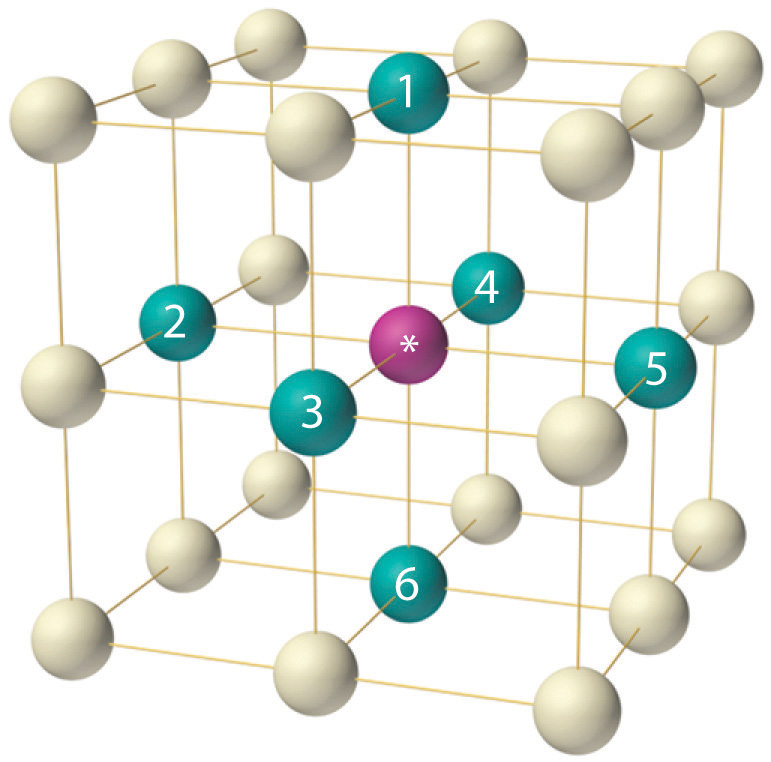
The arrangement of atoms in a simple cubic unit cell. Each atom in the lattice has vi nearest neighbors in an octahedral arrangement.
Body-Centered Cubic Structure
The trunk-centered cubic unit cell is a more efficient way to pack spheres together and is much more common amongst pure elements. Each cantlet has viii nearest neighbors in the unit cell, and 68% of the book is occupied by the atoms. Every bit shown in office (b) in Figure 12.v, the body-centered cubic structure consists of a single layer of spheres in contact with each other and aligned so that their centers are at the corners of a foursquare; a second layer of spheres occupies the square-shaped "holes" in a higher place the spheres in the kickoff layer. The third layer of spheres occupies the square holes formed by the second layer, so that each lies directly in a higher place a sphere in the first layer, and so along. All the alkali metals, barium, radium, and several of the transition metals have body-centered cubic structures.
Hexagonal Shut-Packed and Cubic Shut-Packed Structures
The well-nigh efficient way to pack spheres is the shut-packed arrangement, which has two variants. A single layer of shut-packed spheres is shown in part (a) in Figure 12.half dozen. Each sphere is surrounded by half-dozen others in the same plane to produce a hexagonal system. Above any fix of seven spheres are vi depressions arranged in a hexagon. In principle, all six sites are the same, and any one of them could be occupied by an atom in the next layer. Actually, withal, these 6 sites can be divided into 2 sets, labeled B and C in function (a) in Figure 12.six. Sites B and C differ because as soon every bit nosotros place a sphere at a B position, we tin no longer identify a sphere in whatsoever of the 3 C positions adjacent to A and vice versa.
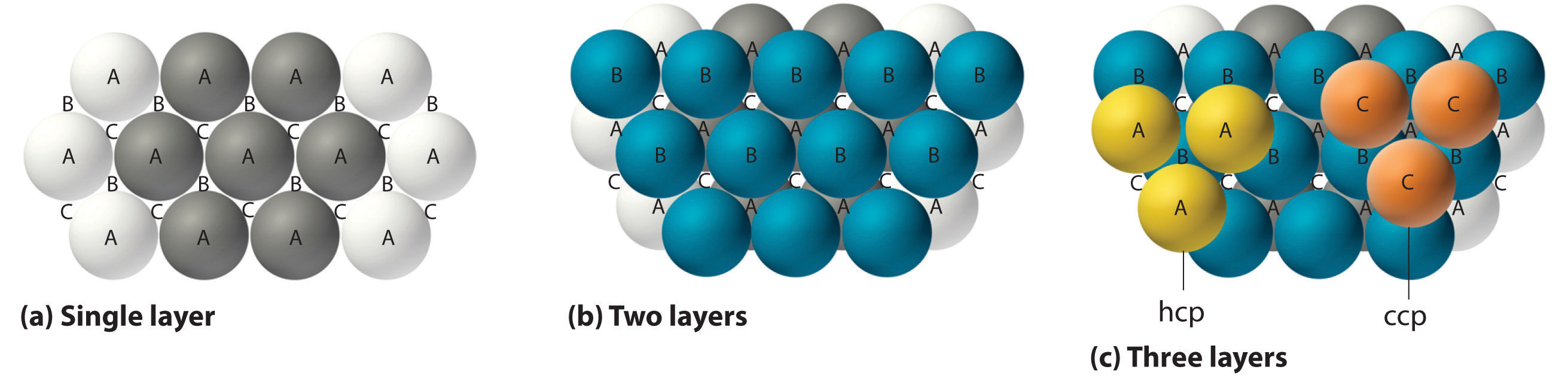
Figure 12.6: Close-Packed Layers of Spheres. (a) In this unmarried layer of close-packed spheres, each sphere is surrounded by 6 others in a hexagonal arrangement. (b) Placing an atom at a B position prohibits placing an atom at any of the next C positions and results in all the atoms in the second layer occupying the B positions. (c) Placing the atoms in the third layer over the atoms at A positions in the first layer gives the hexagonal close-packed structure. Placing the third-layer atoms over the C positions gives the cubic close-packed construction. (CC By-NC-SA; anonymous past request)
If we identify the second layer of spheres at the B positions in part (a) in Effigy 12.6, we obtain the two-layered structure shown in role (b) in Effigy 12.6. There are at present two alternatives for placing the start atom of the third layer: nosotros tin place it straight over one of the atoms in the beginning layer (an A position) or at 1 of the C positions, corresponding to the positions that nosotros did non employ for the atoms in the first or 2nd layers (office (c) in Figure 12.6). If we choose the commencement arrangement and repeat the pattern in succeeding layers, the positions of the atoms alternating from layer to layer in the pattern ABABAB…, resulting in a hexagonal close-packed (hcp) structure (part (a) in Effigy 12.vii). If we choose the second arrangement and repeat the design indefinitely, the positions of the atoms alternate as ABCABC…, giving a cubic shut-packed (ccp) construction (part (b) in Figure 12.7). Considering the ccp structure contains hexagonally packed layers, information technology does not wait particularly cubic. Every bit shown in part (b) in Figure 12.7, however, merely rotating the structure reveals its cubic nature, which is identical to a fcc structure. The hcp and ccp structures differ only in the manner their layers are stacked. Both structures accept an overall packing efficiency of 74%, and in both each cantlet has 12 nearest neighbors (6 in the aforementioned plane plus 3 in each of the planes immediately above and below).
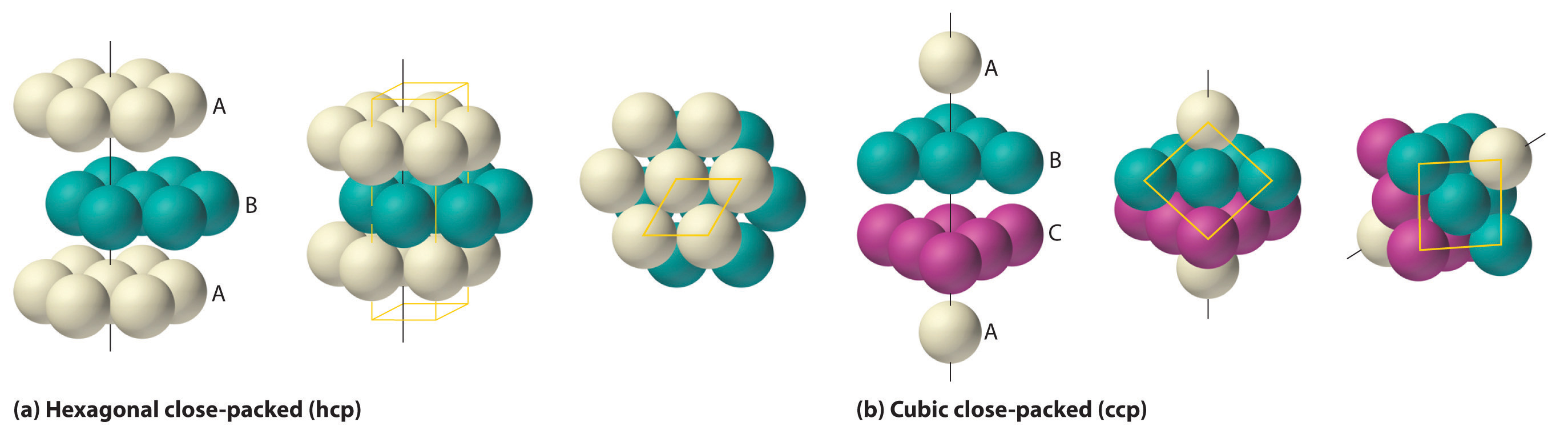
Figure 12.7 Close-Packed Structures: hcp and ccp. The illustrations in (a) show an exploded view, a side view, and a top view of the hcp structure. The simple hexagonal unit prison cell is outlined in the side and top views. Notation the similarity to the hexagonal unit jail cell shown in Figure 12.4. The ccp construction in (b) is shown in an exploded view, a side view, and a rotated view. The rotated view emphasizes the fcc nature of the unit cell (outlined). The line that connects the atoms in the first and 4th layers of the ccp structure is the trunk diagonal of the cube. (CC BY-NC-SA; anonymous by request)
Tabular array 12.one compares the packing efficiency and the number of nearest neighbors for the different cubic and shut-packed structures; the number of nearest neighbors is called the coordination number. Most metals have hcp, ccp, or bcc structures, although several metals exhibit both hcp and ccp structures, depending on temperature and pressure.
Tabular array 12.one: Properties of the Mutual Structures of Metals
| Construction | Percentage of Space Occupied by Atoms | Coordination Number |
|---|---|---|
| simple cubic | 52 | 6 |
| trunk-centered cubic | 68 | 8 |
| hexagonal close packed | 74 | 12 |
| cubic close packed (identical to face up-centered cubic) | 74 | 12 |
Summary
The smallest repeating unit of a crystal lattice is the unit cell. The unproblematic cubic unit cell contains merely eight atoms, molecules, or ions at the corners of a cube. A body-centered cubic (bcc) unit of measurement cell contains one additional component in the middle of the cube. A face-centered cubic (fcc) unit cell contains a component in the center of each face in addition to those at the corners of the cube. Uncomplicated cubic and bcc arrangements fill merely 52% and 68% of the bachelor space with atoms, respectively. The hexagonal close-packed (hcp) structure has an ABABAB… repeating arrangement, and the cubic close-packed (ccp) structure has an ABCABC… repeating design; the latter is identical to an fcc lattice. The hcp and ccp arrangements fill 74% of the available infinite and have a coordination number of 12 for each atom in the lattice, the number of nearest neighbors. The simple cubic and bcc lattices have coordination numbers of 6 and 8, respectively.
Primal Takeaway
A crystalline solid can be represented by its unit of measurement cell, which is the smallest identical unit that when stacked together produces the characteristic three-dimensional structure.
Conceptual Bug
1. Why is it valid to stand for the structure of a crystalline solid past the structure of its unit cell? What are the most important constraints in selecting a unit jail cell?
two. All unit cell structures have six sides. Can crystals of a solid have more six sides? Explain your reply.
3. Explain how the intensive backdrop of a cloth are reflected in the unit cell. Are all the backdrop of a bulk fabric the same as those of its unit jail cell? Explain your answer.
4. The experimentally measured density of a bulk material is slightly higher than expected based on the construction of the pure fabric. Propose ii explanations for this observation.
5. The experimentally adamant density of a cloth is lower than expected based on the arrangement of the atoms in the unit of measurement cell, the formula mass, and the size of the atoms. What decision(s) can you draw about the material?
6. Only one element (polonium) crystallizes with a simple cubic unit of measurement cell. Why is polonium the only case of an chemical element with this structure?
7. What is meant by the term coordination number in the structure of a solid? How does the coordination number depend on the structure of the metal?
eight. Conform the three types of cubic unit cells in social club of increasing packing efficiency. What is the difference in packing efficiency between the hcp structure and the ccp structure?
9. The structures of many metals depend on pressure and temperature. Which structure—bcc or hcp—would be more probable in a given metal at very high pressures? Explain your reasoning.
ten. A metallic has two crystalline phases. The transition temperature, the temperature at which one stage is converted to the other, is 95°C at 1 atm and 135°C at 1000 atm. Sketch a phase diagram for this substance. The metal is known to have either a ccp structure or a simple cubic construction. Label the regions in your diagram appropriately and justify your pick for the structure of each phase.
Numerical Problems
one. Metal rhodium has an fcc unit of measurement jail cell. How many atoms of rhodium does each unit cell contain?
two. Chromium has a structure with 2 atoms per unit cell. Is the structure of this metallic simple cubic, bcc, fcc, or hcp?
iii. The density of nickel is eight.908 one thousand/cm3. If the metal radius of nickel is 125 pm, what is the structure of metallic nickel?
iv. The density of tungsten is nineteen.three g/cm3. If the metallic radius of tungsten is 139 pm, what is the structure of metal tungsten?
5. An element has a density of 10.25 g/cm3 and a metal radius of 136.iii pm. The metal crystallizes in a bcc lattice. Identify the element.
half dozen. A 21.64 g sample of a nonreactive metal is placed in a flask containing 12.00 mL of water; the last volume is 13.81 mL. If the length of the edge of the unit cell is 387 pm and the metal radius is 137 pm, decide the packing arrangement and place the element.
7. A sample of an element of group i that has a bcc unit cell is found to have a mass of 1.000 chiliad and a volume of ane.0298 cm3. When the metal reacts with excess water, the reaction produces 539.29 mL of hydrogen gas at 0.980 atm and 23°C. Place the metal, make up one's mind the unit of measurement cell dimensions, and give the approximate size of the cantlet in picometers.
8. A sample of an alkaline globe metal that has a bcc unit prison cell is found to accept a mass 5.000 yard and a volume of one.392 cmiii. Complete reaction with chlorine gas requires 848.3 mL of chlorine gas at one.050 atm and 25°C. Identify the metal, decide the unit cell dimensions, and requite the guess size of the atom in picometers.
9. Lithium crystallizes in a bcc structure with an edge length of 3.509 Å. Summate its density. What is the approximate metallic radius of lithium in picometers?
10. Vanadium is used in the manufacture of rust-resistant vanadium steel. It forms bcc crystals with a density of 6.11 g/cmthree at xviii.7°C. What is the length of the edge of the unit of measurement cell? What is the guess metallic radius of the vanadium in picometers?
11. A uncomplicated cubic cell contains one metal atom with a metallic radius of 100 pm.
a. Determine the volume of the atom(s) contained in one unit cell [the volume of a sphere = (\({four \over 3} \))πr3].
b. What is the length of one edge of the unit of measurement cell? (Hint: in that location is no empty space between atoms.)
c. Calculate the volume of the unit cell.
d. Determine the packing efficiency for this structure.
e. Use the steps in Problem 11 to calculate the packing efficiency for a bcc unit cell with a metallic radius of one.00 Å.
Numerical Answers
1. four
3. fcc
5. molybdenum
seven. sodium, unit cell border = 428 pm, r = 185 pm
9. d = 0.5335 g/cmthree, r =151.nine pm

Source: https://chem.libretexts.org/Bookshelves/General_Chemistry/Book%3A_General_Chemistry%3A_Principles_Patterns_and_Applications_(Averill)/12%3A_Solids/12.02%3A_The_Arrangement_of_Atoms_in_Crystalline_Solids
Posted by: moorelilly1969.blogspot.com
0 Response to "The Drawing Below Represents The Unit Cell For Which Crystal Structure?"
Post a Comment