

What Foundation Is Similar To Victoria Jackson Makeup
| Victoria, Virginia | |
|---|---|
| Town | |
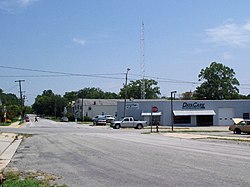 Street scene in Victoria | |
 Location of Victoria, Virginia | |
| Coordinates: 36°59′36″Due north 78°13′30″Due west / 36.99333°N 78.22500°Due west / 36.99333; -78.22500 Coordinates: 36°59′36″Due north 78°13′30″Westward / 36.99333°N 78.22500°Due west / 36.99333; -78.22500 | |
| Country | U.s. |
| State | Virginia |
| County | Lunenburg |
| Named for | Queen Victoria |
| Authorities | |
| • Mayor | Ballad R. Watson (Since 2000) |
| • Boondocks Manager | Rodney Newton |
| Expanse [1] | |
| • Total | 2.85 sq mi (7.38 kmtwo) |
| • Country | 2.82 sq mi (7.29 km2) |
| • Water | 0.03 sq mi (0.09 km2) |
| Elevation | 587 ft (179 1000) |
| Population (2010) | |
| • Total | 1,725 |
| • Guess (2019)[2] | 1,626 |
| • Density | 577.41/sq mi (222.92/km2) |
| Time zone | UTC−5 (Eastern (EST)) |
| • Summer (DST) | UTC−iv (EDT) |
| Zero code | 23974 |
| Area lawmaking(s) | 434 |
| FIPS code | 51-81024[3] |
| GNIS feature ID | 1496356[four] |
| Website | www |
Victoria is an incorporated town in Lunenburg County, Virginia, United States. The population was 1,725 at the 2010 demography, which was downwards from the 1,821 reported in 2000.
History [edit]
Lunenburg Canton in the Southside region was established on May 1, 1746, in Bang-up United kingdom of great britain and northern ireland's Virginia Colony from Brunswick County. The county is named for the former Duchy of Brunswick-Lunenburg in Germany, because one of the titles also carried by United kingdom'south Hanoverian kings was Duke of Brunswick-Lunenburg.
Later statehood, Virginia grew every bit role of the original 13 United States. First in 1816, the Virginia Lath of Public Works began providing engineering and financial assistance to internal improvements around the country in transportation which connected during most of the 19th century. Even so, Lunenburg County had been largely passed by every bit canals, turnpikes, and railroads were congenital across much of Virginia. At the outset of the 20th century, the area which was to become Victoria was mostly farmland (primarily cultivating tobacco) and woodlands.
Born as a railroad boondocks [edit]
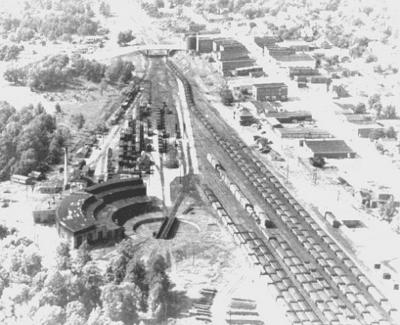
This aerial shot of Victoria was taken in 1954 looking westward. It shows the turntable and roundhouse in the lower left, and the rider station and Norfolk partitioning offices to the right of the tracks
Victoria was founded in 1906 as a planned customs on what had been largely undeveloped state during the construction of the Tidewater Railway. This was a new east–westward railroad chartered in 1904 with its correct of manner quietly secured in 1904 and 1905, and then as to non warning the competition regarding plans to transport coal originated by its sister Deepwater Railway operating in southern Due west Virginia. The Tidewater Railway was chartered to cross Virginia from the West Virginia border near Glen Lyn, Virginia in Giles County by style of Roanoke and Suffolk to port at Sewell'south Point on Hampton Roads well-nigh Norfolk, Virginia. Both railroads were planned and built by the squad of mining manager and civil engineer William Nelson Page and industrialist and financier Henry Huttleston Rogers, and added a tertiary Hampton Roads coal exporting railhead to the existing Chesapeake and Ohio Railway (with coal piers at Newport News) and the Norfolk and Western Railway's similar facilities at Norfolk's Lambert'southward Betoken.
Queen Victoria of the U.k. was a favorite of Henry Rogers, and the new town was named in her honor. Victoria was the midpoint of the VGN's Norfolk Division, which extended from Sewell'due south Point to Roanoke. Designated to be a "division point" on the railroad (specifically a location for crew changes and servicing of the steam locomotives), Victoria became the location of a large equipment maintenance functioning with roundhouse, turntable, coaling and water facilities for servicing steam locomotives, and a large g.
Co-ordinate to writer H. Reid in his 1961 book The Virginian Railway, investors recalled the rapid growth of Roanoke between 1882 and 1884, which had been nicknamed the "Magic City" when the Norfolk and Western (N&W) had established major facilities at the former bucolic location which had been before known as Big Lick. Comparisons were made when speculating about Victoria's future potential. They could also look to nearby Crewe on the North&W (near 20 miles away from Victoria) to run across what a substantial volume of activity and employment a division bespeak on a steam railroad could bring. Predictably, land sales at Victoria were brisk, and buildings (and jobs) soon followed.
In 1907, as they began nearing completion, the Tidewater and Deepwater Railways were combined to form the Virginian Railway (VGN). In March, the Tidewater Railway was formally rechartered by the Virginia State Corporation Committee as "The Virginian Railway Company" and William Nelson Page was elected president on April 15, 1907, at the start new board meeting in Norfolk. On April 22, the Deepwater Railway was acquired, formalizing the marriage of the two roads. Rider service from Victoria to Norfolk began on June 17, 1907. The trip from Victoria took 12 hours, and operated once daily in each management except Sundays, according to the first schedules published in the Norfolk Virginian-Airplane pilot newspaper.
That first summer and autumn, in conjunction with the Norfolk and Southern Railway (a regional predecessor of the 21st century Norfolk Southern Organization), service was offered to the Jamestown Exposition being held in Norfolk County that aforementioned summertime. At the Exposition, VGN president Page served as Chief of International Jury of Awards, Mines and Metallurgy. U.s.a. President Theodore Roosevelt, attention the Jamestown Exposition, was one of the VGN's earliest passengers, co-ordinate to writer Reid.
Side by side to the Jamestown Exposition site on Hampton Roads at Sewell's Bespeak, a new coal pier was beingness built. Completion of the entire railroad took 2 additional years. The low gradient VGN was considered an engineering marvel of the time when information technology was completed in 1909. Soon, coal and other bolt began rolling through Victoria. The new Norfolk Division offices of the railroad were on located on a second flooring which was added to the original Victoria rider station a brusk time later.
The Virginia General Associates granted a lease and incorporated the Town of Victoria on March 11, 1916.
Bechelbronn and Victoria High School are listed on the National Register of Historic Places.[5]
Finish of steam, mergers, abandonment [edit]
Victoria's importance every bit a runway point declined sharply in the 1950s when the modify to diesel-electrical locomotives greatly reduced the labor and facilities needed. The terminal Virginian passenger train served Victoria in January, 1956. VGN steam operations ended completely in June, 1957. And so, on December 1, 1959, the Virginian Railway merged with the larger Norfolk and Western Railway. Under combined operations, the through coal traffic was shifted from Victoria to the bigger route'southward chief line through Crewe, Virginia, within commuting distance for N&W's Victoria-based employees. Local customers on the former VGN line through Victoria and nearby Kenbridge were few, and the portion of the line through Victoria and Kenbridge was somewhen abandoned in the 1980s. All tracks and almost all structures were removed, and a portion of the land donated to the community past North&Due west.
Much like many other communities all across the United states, the end of steam railroading and the era of mergers and consolidation in the second half of the 20th century reduced rail-oriented employment opportunities and had a mostly negative bear on upon Victoria and the surrounding area. However, the community and Lunenburg County proved resilient, and by the late 1990s, transportation employment represented only a minimal portion of the area's economic system.
1 of the biggest industries in Victoria is the prison industry. Located two miles from the centre of town, the Lunenburg Correctional Center provides employment for many people living in and effectually Victoria.
Remembering Victoria's rail heritage [edit]
Early in the 21st century, piece of work was begun to develop a rail heritage park and obtain a caboose to help present the town's rail heritage. After several years of work, 1 of the last C-ten cabooses built in-firm by VGN employees at the visitor's massive shops complex in Princeton, West Virginia in the 1950s was located.
Track preservationist, historian, and lensman Kenneth Miller of Roanoke had purchased Caboose 342 in the 1980s, and working with his male parent, had carefully restored it over a menses of years. Miller, a long-time VGN fan, agreed to let Victoria have what is considered by many to be the finest extant VGN caboose for the new rails heritage park.
To prepare an appropriate display area for Caboose 342, a short stretch of roadbed was prepared, ballasted, and ties and rail were laid by volunteers in Victoria. The initials "H.H.R." and "Due west.Due north.P." were engraved equally a lasting tribute to the founders of the Virginian Railway, industrialist and financier Henry Huttleston Rogers and coal mining director and civil engineer William Nelson Page.

Virginian Railway restored and fully equipped caboose # 342 placed on static brandish in the town of Victoria
Tardily in 2004, Norfolk Southern advisedly transported Caboose 342 from Roanoke to the NS rail thou at Crewe, Virginia past rail. From there, it traveled overland by truck and was placed on the new rails at Victoria on December 22, 2004. In Victoria, information technology has been placed on display fully equipped, and has get a popular attraction for schoolhouse groups and retired railroaders akin.
Geography [edit]
Victoria is located at 36°59′36″Northward 78°13′xxx″W / 36.99333°N 78.22500°W / 36.99333; -78.22500 (36.993365, −78.224891).[half-dozen]
According to the Us Census Agency, the town has a total expanse of 2.9 foursquare miles (vii.four kmtwo), of which, 2.eight square miles (seven.3 km2) of it is land and 0.04 foursquare miles (0.one km2) of it (1.05%) is water.
Demographics [edit]
| Historical population | |||
|---|---|---|---|
| Census | Popular. | %± | |
| 1910 | 682 | — | |
| 1920 | ane,445 | 111.nine% | |
| 1930 | 1,568 | 8.v% | |
| 1940 | 1,555 | −0.8% | |
| 1950 | ane,607 | 3.3% | |
| 1960 | 1,737 | viii.1% | |
| 1970 | 1,408 | −xviii.9% | |
| 1980 | two,004 | 42.3% | |
| 1990 | 1,830 | −8.7% | |
| 2000 | 1,821 | −0.5% | |
| 2010 | one,725 | −5.3% | |
| 2019 (est.) | 1,626 | [ii] | −5.7% |
| U.Due south. Decennial Census[7] | |||
Every bit of the demography[three] of 2000, at that place were i,821 people, 803 households, and 517 families residing in the boondocks. The population density was 644.6 people per foursquare mile (248.4/km2). There were 903 housing units at an average density of 319.6 per foursquare mile (123.2/kmii). The racial makeup of the town was 76.22% White, 21.47% African American, 0.16% Native American, 0.05% Asian, 0.38% from other races, and 1.70% from ii or more than races. Hispanic or Latino of whatever race were i.37% of the population.
There were 803 households, out of which 26.3% had children under the age of eighteen living with them, 45.i% were married couples living together, fifteen.ii% had a female householder with no husband present, and 35.6% were non-families. 33.0% of all households were made upward of individuals, and 18.4% had someone living alone who was 65 years of historic period or older. The average household size was 2.27 and the average family unit size was ii.85.
In the town, the population was spread out, with 22.8% under the age of eighteen, 7.9% from 18 to 24, 22.nine% from 25 to 44, 25.three% from 45 to 64, and 21.0% who were 65 years of age or older. The median age was 42 years. For every 100 females, there were 85.6 males. For every 100 females historic period 18 and over, in that location were 80.4 males.
The median income for a household in the town was $24,694, and the median income for a family unit was $32,311. Males had a median income of $26,797 versus $17,054 for females. The per capita income for the town was $thirteen,693. Nearly xviii.6% of families and 24.half-dozen% of the population were below the poverty line, including 38.9% of those nether age eighteen and xviii.2% of those age 65 or over.
References [edit]
- ^ "2019 U.S. Gazetteer Files". United states Census Bureau. Retrieved August 7, 2020.
- ^ a b "Population and Housing Unit Estimates". United States Census Bureau. May 24, 2020. Retrieved May 27, 2020.
- ^ a b "U.S. Demography website". The states Census Bureau. Retrieved 2008-01-31 .
- ^ "US Lath on Geographic Names". United states Geological Survey. 2007-ten-25. Retrieved 2008-01-31 .
- ^ "National Register Information System". National Register of Historic Places. National Park Service. July nine, 2010.
- ^ "United states of america Gazetteer files: 2010, 2000, and 1990". Us Census Bureau. 2011-02-12. Retrieved 2011-04-23 .
- ^ "Census of Population and Housing". Census.gov. Retrieved June 4, 2015.
Further reading [edit]
- Lewis, Lloyd D. (1994) Norfolk & Western and Virginian Railways in Color by H. Reid. Lynchburg, Virginia: TLC Publishing Inc. ISBN 1-883089-09-three
- Reid, H. (1961) The Virginian Railway. Milwaukee, WI: Kalmback Publishing
- Reisweber, Kurt (1995) Virginian Rails 1953-1993 (1st ed.) Quondam Line Graphics. ISBN 1-879314-eleven-8
- Striplin, East. F. Pat. (1981) The Norfolk & Western : a history Roanoke, Va. : Norfolk and Western Railway Co. ISBN 0-9633254-half dozen-nine
- Traser, Donald R. (1998) Virginia Railway Depots. Former Dominion Affiliate, National Railway Historical Society. ISBN 0-9669906-0-nine
- Wiley, Aubrey and Wallace, Conley (1985). The Virginian Railway Handbook. Lynchburg, Virginia: W-West Publications.
Journal, concern, and on-line publications [edit]
- Beale, Frank D. (1955) The Virginian Railway Company 45th Almanac Report Yr Ended December 31, 1954. published in-house
- Cuthriell, N.L. (1956) Coal On The Motility Via The Virginian Railway, reprinted with permission of Norfolk Southern Corporation in 1995 by Norfolk & Western Historical Gild, Inc. ISBN 0-9633254-two-6
- Reid, H. (1953) "Trains & Travel Mag" December, 1953 "Some Fine Engines" Kalmbach Publishing Co.
- Norfolk Virginian-Pilot newspaper, June sixteen, 1907, advertisement
External links [edit]
- Victoria, Virginia homepage
- Virginian Railway (VGN) Enthusiasts non-profit group of preservationists, authors, photographers, historians, modelers, and railfans
Source: https://en.wikipedia.org/wiki/Victoria,_Virginia
Posted by: moorelilly1969.blogspot.com
0 Response to "What Foundation Is Similar To Victoria Jackson Makeup"
Post a Comment