

What Is The Chemical Makeup Of Our Breath
Breathing (or ventilation) is the process of moving air into and from the lungs to facilitate gas exchange with the internal environs, mostly to flush out carbon dioxide and bring in oxygen.
All aerobic creatures demand oxygen for cellular respiration, which extracts free energy from the reaction of oxygen with molecules derived from food and produces carbon dioxide as a waste matter. Breathing, or "external respiration", brings air into the lungs where gas exchange takes place in the alveoli through diffusion. The trunk'southward circulatory system transports these gases to and from the cells, where "cellular respiration" takes place.[one] [two]
The breathing of all vertebrates with lungs consists of repetitive cycles of inhalation and exhalation through a highly branched organization of tubes or airways which lead from the olfactory organ to the alveoli.[3] The number of respiratory cycles per minute is the breathing or respiratory charge per unit, and is one of the four primary vital signs of life.[four] Nether normal conditions the breathing depth and charge per unit is automatically, and unconsciously, controlled by several homeostatic mechanisms which go on the partial pressures of carbon dioxide and oxygen in the arterial blood constant. Keeping the fractional pressure level of carbon dioxide in the arterial blood unchanged under a broad variety of physiological circumstances, contributes significantly to tight control of the pH of the extracellular fluids (ECF). Over-breathing (hyperventilation) and under-breathing (hypoventilation), which subtract and increase the arterial partial pressure level of carbon dioxide respectively, cause a ascent in the pH of ECF in the start instance, and a lowering of the pH in the second. Both cause distressing symptoms.
Animate has other important functions. Information technology provides a mechanism for speech, laughter and similar expressions of the emotions. It is also used for reflexes such as yawning, coughing and sneezing. Animals that cannot thermoregulate by perspiration, because they lack sufficient sweat glands, may lose heat by evaporation through panting.
Mechanics [edit]


In this view of the rib muzzle the downward slope of the lower ribs from the midline outwards can be clearly seen. This allows a motility similar to the "pump handle upshot", but in this instance, information technology is chosen the saucepan handle motility. The color of the ribs refers to their classification and is not relevant here.
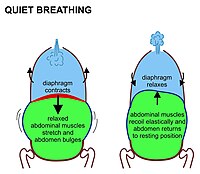
The muscles of breathing at rest: inhalation on the left, exhalation on the right. Contracting muscles are shown in red; relaxed muscles in blue. Contraction of the diaphragm generally contributes the most to the expansion of the chest cavity (calorie-free bluish). However, at the same fourth dimension, the intercostal muscles pull the ribs upwards (their consequence is indicated by arrows) also causing the rib cage to expand during inhalation (see diagram on some other side of the folio). The relaxation of all these muscles during exhalation causes the rib cage and belly (lite light-green) to elastically render to their resting positions. Compare these diagrams with the MRI video at the top of the page.

The muscles of forceful breathing (inhalation and exhalation). The color code is the aforementioned as on the left. In addition to a more forceful and extensive contraction of the diaphragm, the intercostal muscles are aided by the accessory muscles of inhalation to exaggerate the motility of the ribs upwardly, causing a greater expansion of the rib cage. During exhalation, apart from the relaxation of the muscles of inhalation, the abdominal muscles actively contract to pull the lower edges of the rib cage downwards decreasing the volume of the rib muzzle, while at the same time pushing the diaphragm upwards deep into the thorax.
The lungs are not capable of inflating themselves, and will aggrandize only when there is an increase in the volume of the thoracic cavity.[v] [vi] In humans, as in the other mammals, this is accomplished primarily through the contraction of the diaphragm, but also by the contraction of the intercostal muscles which pull the rib muzzle upwards and outwards equally shown in the diagrams on the right.[7] During forceful inhalation (Figure on the right) the accessory muscles of inhalation, which connect the ribs and sternum to the cervical vertebrae and base of the skull, in many cases through an intermediary attachment to the clavicles, exaggerate the pump handle and bucket handle movements (run into illustrations on the left), bringing nearly a greater alter in the book of the breast cavity.[7] During exhalation (breathing out), at balance, all the muscles of inhalation relax, returning the chest and abdomen to a position called the "resting position", which is determined past their anatomical elasticity.[7] At this signal the lungs contain the functional residual capacity of air, which, in the adult human, has a book of well-nigh 2.5–3.0 liters.[7]
During heavy breathing (hyperpnea) as, for instance, during exercise, exhalation is brought about by relaxation of all the muscles of inhalation, (in the same way every bit at rest), but, in add-on, the intestinal muscles, instead of being passive, at present contract strongly causing the rib cage to exist pulled downwards (front and sides).[7] This not just decreases the size of the rib cage but also pushes the abdominal organs upward against the diaphragm which consequently bulges deeply into the thorax. The end-exhalatory lung volume is now less air than the resting "functional residual capacity".[7] However, in a normal mammal, the lungs cannot be emptied completely. In an adult man, there is always still at least one liter of residual air left in the lungs after maximum exhalation.[7]
Diaphragmatic animate causes the abdomen to rhythmically bulge out and fall dorsum. Information technology is, therefore, often referred to every bit "intestinal breathing". These terms are oft used interchangeably because they describe the same activity.
When the accessory muscles of inhalation are activated, particularly during labored breathing, the clavicles are pulled upwardly, as explained higher up. This external manifestation of the use of the accessory muscles of inhalation is sometimes referred to as clavicular breathing, seen specially during asthma attacks and in people with chronic obstructive pulmonary illness.
Passage of air [edit]

This is a diagram showing how inhalation and exhalation is controlled by a variety of muscles, and what that looks like from a full general overall view.
Upper airways [edit]

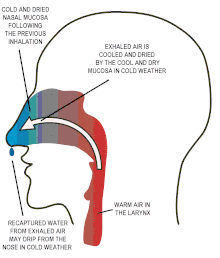
Inhaled air is warmed and moistened past the wet, warm nasal mucosa, which consequently cools and dries. When warm, wet air from the lungs is breathed out through the nose, the cold hygroscopic mucus in the cool and dry out nose re-captures some of the warmth and moisture from that exhaled air. In very common cold weather condition the re-captured water may crusade a "dripping nose".
Ideally, air is breathed get-go out and secondly in through the olfactory organ. The nasal cavities (between the nostrils and the pharynx) are quite narrow, firstly past beingness divided in two by the nasal septum, and secondly past lateral walls that take several longitudinal folds, or shelves, called nasal conchae,[8] thus exposing a big area of nasal mucous membrane to the air as information technology is inhaled (and exhaled). This causes the inhaled air to take up moisture from the wet fungus, and warmth from the underlying claret vessels, then that the air is very nearly saturated with water vapor and is at nearly body temperature by the time it reaches the larynx.[vii] Part of this moisture and heat is recaptured every bit the exhaled air moves out over the partially dried-out, cooled mucus in the nasal passages, during exhalation. The sticky fungus also traps much of the particulate matter that is breathed in, preventing it from reaching the lungs.[7] [8]
Lower airways [edit]
The anatomy of a typical mammalian respiratory system, beneath the structures normally listed amongst the "upper airways" (the nasal cavities, the pharynx, and larynx), is oft described as a respiratory tree or tracheobronchial tree (figure on the left). Larger airways give rise to branches that are slightly narrower, but more than numerous than the "trunk" airway that gives rise to the branches. The man respiratory tree may consist of, on boilerplate, 23 such branchings into progressively smaller airways, while the respiratory tree of the mouse has up to 13 such branchings. Proximal divisions (those closest to the top of the tree, such as the trachea and bronchi) function mainly to transmit air to the lower airways. Later divisions such equally the respiratory bronchioles, alveolar ducts and alveoli are specialized for gas exchange.[7] [9]
The trachea and the first portions of the main bronchi are outside the lungs. The residue of the "tree" branches within the lungs, and ultimately extends to every function of the lungs.
The alveoli are the blind-ended terminals of the "tree", significant that any air that enters them has to leave the same way it came. A organization such as this creates dead space, a term for the volume of air that fills the airways at the cease of inhalation, and is breathed out, unchanged, during the next exhalation, never having reached the alveoli. Similarly, the dead space is filled with alveolar air at the terminate of exhalation, which is the kickoff air to breathed back into the alveoli during inhalation, earlier any fresh air which follows after it. The expressionless infinite volume of a typical adult human is about 150 ml.
Gas commutation [edit]
The primary purpose of animate is to refresh air in the alveoli and so that gas commutation can take identify in the blood. The equilibration of the partial pressures of the gases in the alveolar blood and the alveolar air occurs past diffusion. Later on exhaling, adult human lungs still contain two.5–3 L of air, their functional residual capacity or FRC. On inhalation, only almost 350 mL of new, warm, moistened atmospheric air is brought in and is well mixed with the FRC. Consequently, the gas limerick of the FRC changes very trivial during the breathing cycle. This ways that the pulmonary, capillary blood ever equilibrates with a relatively constant air limerick in the lungs and the diffusion rate with arterial blood gases remains equally constant with each breath. Body tissues are therefore non exposed to large swings in oxygen and carbon dioxide tensions in the claret acquired by the breathing cycle, and the peripheral and central chemoreceptors mensurate only gradual changes in dissolved gases. Thus the homeostatic control of the breathing rate depends simply on the partial pressures of oxygen and carbon dioxide in the arterial blood, which and then also maintains a constant pH of the claret.[7]
Command [edit]
The rate and depth of breathing is automatically controlled by the respiratory centers that receive information from the peripheral and primal chemoreceptors. These chemoreceptors continuously monitor the fractional pressures of carbon dioxide and oxygen in the arterial blood. The first of these sensors are the central chemoreceptors on the surface of the medulla oblongata of the brain stem which are particularly sensitive to pH as well equally the partial pressure of carbon dioxide in the blood and cerebrospinal fluid.[7] The 2d group of sensors measure the partial pressure level of oxygen in the arterial blood. Together the latter are known every bit the peripheral chemoreceptors, and are situated in the aortic and carotid bodies.[7] Information from all of these chemoreceptors is conveyed to the respiratory centers in the pons and medulla oblongata, which responds to fluctuations in the partial pressures of carbon dioxide and oxygen in the arterial claret by adjusting the charge per unit and depth of breathing, in such a way every bit to restore the fractional pressure of carbon dioxide to five.3 kPa (twoscore mm Hg), the pH to 7.4 and, to a lesser extent, the partial pressure of oxygen to 13 kPa (100 mm Hg).[7] For example, exercise increases the production of carbon dioxide by the agile muscles. This carbon dioxide diffuses into the venous blood and ultimately raises the partial pressure of carbon dioxide in the arterial blood. This is immediately sensed by the carbon dioxide chemoreceptors on the brain stem. The respiratory centers respond to this information by causing the rate and depth of breathing to increase to such an extent that the partial pressures of carbon dioxide and oxygen in the arterial blood return about immediately to the aforementioned levels as at rest. The respiratory centers communicate with the muscles of breathing via motor nerves, of which the phrenic nerves, which innervate the diaphragm, are probably the near of import.[seven]
Automated animate can be overridden to a limited extent past unproblematic selection, or to facilitate swimming, speech, singing or other vocal training. It is impossible to suppress the urge to exhale to the bespeak of hypoxia only training can increase the ability to concur one'southward jiff. Witting breathing practices have been shown to promote relaxation and stress relief but accept not been proven to accept any other health benefits.[10]
Other automatic animate command reflexes also exist. Submersion, particularly of the confront, in cold water, triggers a response called the diving reflex.[eleven] [12] This has the initial outcome of shutting downward the airways confronting the influx of water. The metabolic charge per unit slows right down. This is coupled with intense vasoconstriction of the arteries to the limbs and abdominal viscera, reserving the oxygen that is in blood and lungs at the commencement of the dive well-nigh exclusively for the eye and the encephalon.[11] The diving reflex is an often-used response in animals that routinely need to dive, such as penguins, seals and whales.[13] [14] Information technology is also more than effective in very young infants and children than in adults.[15]
Limerick [edit]
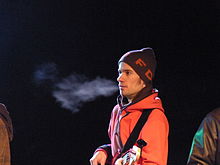
Following on from the above diagram, if the exhaled air is breathed out through the mouth on a cold and humid conditions, the h2o vapor will condense into a visible cloud or mist.
Inhaled air is by volume 78% nitrogen, 20.95% oxygen and small amounts of other gases including argon, carbon dioxide, neon, helium, and hydrogen.[16]
The gas exhaled is iv% to 5% by volume of carbon dioxide, about a 100 fold increase over the inhaled amount. The book of oxygen is reduced by a small corporeality, 4% to five%, compared to the oxygen inhaled. The typical limerick is:[17]
- 5.0–vi.3% water vapor
- 79% nitrogen [eighteen]
- thirteen.6–16.0% oxygen
- 4.0–5.iii% carbon dioxide
- i% argon
- parts per meg (ppm) of hydrogen, from the metabolic activity of microorganisms in the large intestine.[19]
- ppm of carbon monoxide from deposition of heme proteins.
- 1 ppm of ammonia.
- Trace many hundreds of volatile organic compounds especially isoprene and acetone. The presence of certain organic compounds indicate disease.[twenty] [21]
In addition to air, underwater defined practicing technical diving may breathe oxygen-rich, oxygen-depleted or helium-rich breathing gas mixtures. Oxygen and analgesic gases are sometimes given to patients nether medical intendance. The atmosphere in space suits is pure oxygen. Yet, this is kept at around twenty% of Earthbound atmospheric force per unit area to regulate the rate of inspiration.[ citation needed ]
Effects of ambient air pressure [edit]
Animate at altitude [edit]

Fig. iv Atmospheric pressure
Atmospheric pressure decreases with the top above sea level (altitude) and since the alveoli are open to the exterior air through the open airways, the force per unit area in the lungs besides decreases at the same charge per unit with altitude. At altitude, a pressure differential is all the same required to drive air into and out of the lungs as it is at body of water level. The mechanism for breathing at distance is essentially identical to breathing at body of water level just with the following differences:
The atmospheric pressure decreases exponentially with altitude, roughly halving with every 5,500 metres (18,000 ft) rising in distance.[22] The composition of atmospheric air is, nevertheless, nigh constant below eighty km, equally a result of the continuous mixing effect of the weather.[23] The concentration of oxygen in the air (mmols O2 per liter of air) therefore decreases at the same rate as the atmospheric pressure level.[23] At sea level, where the ambient pressure is virtually 100 kPa, oxygen contributes 21% of the atmosphere and the fractional pressure of oxygen ( P Otwo ) is 21 kPa (i.eastward. 21% of 100 kPa). At the top of Mount Everest, 8,848 metres (29,029 ft), where the full atmospheric force per unit area is 33.7 kPa, oxygen still contributes 21% of the atmosphere simply its fractional pressure is only 7.1 kPa (i.e. 21% of 33.7 kPa = 7.1 kPa).[23] Therefore, a greater volume of air must be inhaled at altitude than at sea level in guild to breathe in the same amount of oxygen in a given menstruation.
During inhalation, air is warmed and saturated with water vapor as it passes through the nose and pharynx before it enters the alveoli. The saturated vapor pressure of water is dependent only on temperature; at a body core temperature of 37 °C information technology is 6.3 kPa (47.0 mmHg), regardless of whatever other influences, including distance.[24] Consequently, at sea level, the tracheal air (immediately earlier the inhaled air enters the alveoli) consists of: h2o vapor ( P H2O = six.3 kPa), nitrogen ( P Nii = 74.0 kPa), oxygen ( P O2 = nineteen.7 kPa) and trace amounts of carbon dioxide and other gases, a full of 100 kPa. In dry out air, the P O2 at sea level is 21.0 kPa, compared to a P Oii of 19.7 kPa in the tracheal air (21% of [100 – six.3] = nineteen.vii kPa). At the peak of Mount Everest tracheal air has a full pressure of 33.vii kPa, of which 6.three kPa is h2o vapor, reducing the P Otwo in the tracheal air to 5.8 kPa (21% of [33.7 – 6.iii] = 5.eight kPa), across what is accounted for by a reduction of atmospheric pressure lonely (7.1 kPa).
The pressure gradient forcing air into the lungs during inhalation is also reduced past altitude. Doubling the volume of the lungs halves the pressure in the lungs at whatsoever altitude. Having the ocean level air pressure (100 kPa) results in a pressure gradient of 50 kPa just doing the same at 5500 m, where the atmospheric pressure level is l kPa, a doubling of the volume of the lungs results in a pressure gradient of the merely 25 kPa. In practice, because we breathe in a gentle, cyclical manner that generates pressure gradients of merely 2–3 kPa, this has little effect on the actual charge per unit of inflow into the lungs and is easily compensated for past breathing slightly deeper.[25] [26] The lower viscosity of air at altitude allows air to period more hands and this also helps compensate for any loss of pressure gradient.
All of the to a higher place effects of low atmospheric pressure on breathing are unremarkably accommodated by increasing the respiratory minute volume (the volume of air breathed in — or out — per minute), and the mechanism for doing this is automatic. The exact increase required is determined by the respiratory gases homeostatic mechanism, which regulates the arterial P O2 and P COii . This homeostatic machinery prioritizes the regulation of the arterial P CO2 over that of oxygen at sea level. That is to say, at sea level the arterial P COtwo is maintained at very close to 5.iii kPa (or 40 mmHg) under a broad range of circumstances, at the expense of the arterial P O2 , which is allowed to vary within a very wide range of values, before eliciting a corrective ventilatory response. However, when the atmospheric pressure (and therefore the atmospheric P O2 ) falls to beneath 75% of its value at body of water level, oxygen homeostasis is given priority over carbon dioxide homeostasis. This switch-over occurs at an elevation of about 2,500 metres (eight,200 ft). If this switch occurs relatively abruptly, the hyperventilation at high altitude will cause a severe fall in the arterial P CO2 with a consequent rise in the pH of the arterial plasma leading to respiratory alkalosis. This is one correspondent to high distance sickness. On the other hand, if the switch to oxygen homeostasis is incomplete, and then hypoxia may complicate the clinical picture with potentially fatal results.
Breathing at depth [edit]

Typical breathing effort when breathing through a diving regulator
Pressure increases with the depth of water at the rate of near one atmosphere — slightly more than 100 kPa, or i bar, for every 10 meters. Air breathed underwater by defined is at the ambience pressure of the surrounding h2o and this has a complex range of physiological and biochemical implications. If non properly managed, breathing compressed gasses underwater may lead to several diving disorders which include pulmonary barotrauma, decompression sickness, nitrogen narcosis, and oxygen toxicity. The effects of animate gasses under pressure are farther complicated by the use of one or more than special gas mixtures.
Air is provided by a diving regulator, which reduces the loftier pressure in a diving cylinder to the ambient pressure. The breathing performance of regulators is a factor when choosing a suitable regulator for the blazon of diving to be undertaken. It is desirable that breathing from a regulator requires depression effort even when supplying big amounts of air. Information technology is also recommended that it supplies air smoothly without any sudden changes in resistance while inhaling or exhaling. In the graph, correct, annotation the initial spike in pressure on exhaling to open the exhaust valve and that the initial driblet in pressure level on inhaling is soon overcome equally the Venturi effect designed into the regulator to allow an easy describe of air. Many regulators have an adjustment to alter the ease of inhaling so that animate is effortless.
Respiratory disorders [edit]
| Breathing Patterns | |
|---|---|
 | |
| Graph showing normal as well as different kinds of pathological animate patterns. |
Abnormal animate patterns include Kussmaul breathing, Biot'due south respiration and Cheyne–Stokes respiration.
Other animate disorders include shortness of breath (dyspnea), stridor, apnea, sleep apnea (almost commonly obstructive sleep apnea), mouth breathing, and snoring. Many conditions are associated with obstructed airways. Chronic mouth breathing may be associated with illness.[27] [28] Hypopnea refers to overly shallow breathing; hyperpnea refers to fast and deep breathing brought on past a demand for more oxygen, as for instance by exercise. The terms hypoventilation and hyperventilation also refer to shallow breathing and fast and deep breathing respectively, but nether inappropriate circumstances or illness. However, this distinction (between, for instance, hyperpnea and hyperventilation) is not always adhered to, so that these terms are oft used interchangeably.[29]
A range of jiff tests can be used to diagnose diseases such as dietary intolerances. A rhinomanometer uses acoustic technology to examine the air menses through the nasal passages.[thirty]
Club and civilization [edit]
The word "spirit" comes from the Latin spiritus, meaning breath. Historically, breath has frequently been considered in terms of the concept of life strength. The Hebrew Bible refers to God animate the breath of life into dirt to brand Adam a living soul (nephesh). Information technology also refers to the breath as returning to God when a mortal dies. The terms spirit, prana, the Polynesian mana, the Hebrew ruach and the psyche in psychology are related to the concept of breath.[31]
In T'ai chi, aerobic exercise is combined with breathing exercises to strengthen the diaphragm muscles, amend posture and make improve use of the trunk'due south qi. Different forms of meditation, and yoga advocate various breathing methods. A class of Buddhist meditation called anapanasati significant mindfulness of breath was get-go introduced past Buddha. Breathing disciplines are incorporated into meditation, certain forms of yoga such equally pranayama, and the Buteyko method as a treatment for asthma and other conditions.[32]
In music, some wind instrument players use a technique called round breathing. Singers as well rely on breath control.
Common cultural expressions related to breathing include: "to catch my breath", "took my breath away", "inspiration", "to expire", "go my breath back".
Breathing and mood [edit]
Sure animate patterns take a tendency to occur with certain moods. Due to this human relationship, practitioners of diverse disciplines consider that they can encourage the occurrence of a particular mood by adopting the breathing pattern that it most commonly occurs in conjunction with. For example, and perhaps the most mutual recommendation is that deeper animate which utilizes the diaphragm and abdomen more can encourage relaxation.[10] [33] Practitioners of different disciplines often interpret the importance of breathing regulation and its perceived influence on mood in different ways. Buddhists may consider that it helps precipitate a sense of inner-peace, holistic healers that it encourages an overall state of wellness[34] and business organisation advisers that it provides relief from work-based stress.
Breathing and physical practice [edit]

A young gymnast breathes deeply before performing his practise.
During physical do, a deeper animate pattern is adapted to facilitate greater oxygen absorption. An additional reason for the adoption of a deeper animate blueprint is to strengthen the body'south core. During the process of deep breathing, the thoracic diaphragm adopts a lower position in the cadre and this helps to generate intra-abdominal pressure which strengthens the lumbar spine.[35] Typically, this allows for more powerful physical movements to be performed. As such, it is oftentimes recommended when lifting heavy weights to take a deep breath or prefer a deeper breathing pattern.
See as well [edit]
- Agonal respiration – Abnormal design of breathing (not related to death rattle)
- Ataxic respiration
- Bad breath – Presence of unpleasant odors in exhaled breath
- Jiff gas analysis
- Animate gas – Gas used for human respiration
- Carbon cycle – Natural processes of carbon exchange
- Cardinal sleep apnea – Sleep-related disorder in which the effort to breathe is diminished
- Eupnea – Natural, comfy form of breathing in mammals
- Liquid animate – Respiration of oxygen-rich liquid past a normally air-breathing organism
- Oral fissure breathing – Breathing method in humans
- Nasal bike
- Nitrogen washout – Test for measuring anatomic dead space in the lung during a respiratory cycle
- Obligate nasal breathing
- Respiratory adaptation
Further reading [edit]
- Nestor, James (2020). Jiff: The New Science of a Lost Fine art. Riverhead Books. ISBN978-0735213616.
- Parkes M (2006). "Jiff-property and its breakpoint". Exp Physiol. 91 (1): one–fifteen. doi:10.1113/expphysiol.2005.031625. PMID 16272264.
References [edit]
- ^ Hall, John (2011). Guyton and Hall textbook of medical physiology (12th ed.). Philadelphia, Pa.: Saunders/Elsevier. p. 5. ISBN978-1-4160-4574-8.
- ^ Pocock, Gillian; Richards, Christopher D. (2006). Human physiology : the basis of medicine (3rd ed.). Oxford: Oxford University Press. p. 311. ISBN978-0-19-856878-0.
- ^ Pocock, Gillian; Richards, Christopher D. (2006). Homo physiology : the basis of medicine (3rd ed.). Oxford: Oxford University Press. p. 320. ISBN978-0-19-856878-0.
- ^ "Vital Signs 101". www.hopkinsmedicine.org.
- ^ Pocock, Gillian; Richards, Christopher D. (2006). Man physiology : the basis of medicine (third ed.). Oxford: Oxford Academy Printing. p. 316. ISBN978-0-xix-856878-0.
- ^ Levitzky, Michael G. (2013). Pulmonary physiology (8th ed.). New York: McGraw-Hill Medical. p. Chapter ane. Office and Structure of the Respiratory Arrangement. ISBN978-0-07-179313-1.
- ^ a b c d e f g h i j chiliad 50 m due north o Tortora, Gerard J.; Anagnostakos, Nicholas P. (1987). Principles of beefcake and physiology (5th ed.). New York: Harper & Row, Publishers. pp. 556–582. ISBN978-0-06-350729-6.
- ^ a b Williams, Peter 50; Warwick, Roger; Dyson, Mary; Bannister, Lawrence H. (1989). Grayness's Beefcake (Thirty-seventh ed.). Edinburgh: Churchill Livingstone. pp. 1172–1173, 1278–1282. ISBN0443-041776.
- ^ Gilroy, Anne M.; MacPherson, Brian R.; Ross, Lawrence 1000. (2008). Atlas of Anatomy. Stuttgart: Thieme. pp. 108–111. ISBN978-1-60406-062-ane.
- ^ a b Ades TB, ed. (2009). "Breathwork". American Cancer Society Complete Guide to Complementary and Alternative Cancer Therapies (2nd ed.). American Cancer Society. pp. 72–74. ISBN9780944235713.
- ^ a b Michael Panneton, W (2013). "The Mammalian Diving Response: An Enigmatic Reflex to Preserve Life?". Physiology. 28 (5): 284–297. doi:10.1152/physiol.00020.2013. PMC3768097. PMID 23997188.
- ^ Lindholm, Peter; Lundgren, Claes EG (1 January 2009). "The physiology and pathophysiology of human breath-agree diving". Journal of Practical Physiology. 106 (1): 284–292. doi:10.1152/japplphysiol.90991.2008. PMID 18974367. Retrieved four April 2015.
- ^ Thornton SJ, Hochachka PW (2004). "Oxygen and the diving seal". Undersea Hyperb Med. 31 (1): 81–95. PMID 15233163. Archived from the original on 2008-12-eleven. Retrieved 2008-06-14 .
- ^ Zapol WM, Loma RD, Qvist J, Falke Chiliad, Schneider RC, Liggins GC, Hochachka Pow (September 1989). "Arterial gas tensions and hemoglobin concentrations of the freely diving Weddell seal". Undersea Biomed Res. 16 (5): 363–73. PMID 2800051. Archived from the original on 2008-12-11. Retrieved 2008-06-14 .
- ^ Pedroso, F. Southward.; Riesgo, R. Due south.; Gatiboni, T; Rotta, North. T. (2012). "The diving reflex in good for you infants in the first year of life". Journal of Kid Neurology. 27 (2): 168–71. doi:ten.1177/0883073811415269. PMID 21881008. S2CID 29653062.
- ^ "Earth Fact Canvass". nssdc.gsfc.nasa.gov.
- ^ P.Due south.Dhami; Yard.Chopra; H.N. Shrivastava (2015). A Textbook of Biology. Jalandhar, Punjab: Pradeep Publications. pp. V/101.
- ^ "Gas commutation in the lungs - Respiratory organization - GCSE Biology (Single Science) Revision". BBC Bitesize.
- ^ Eisenmann, Alexander; Amann, Anton; Said, Michael; Datta, Bettina; Ledochowski, Maximilian (2008). "Implementation and interpretation of hydrogen breath tests". Journal of Breath Inquiry. two (four): 046002. Bibcode:2008JBR.....2d6002E. doi:10.1088/1752-7155/ii/four/046002. PMID 21386189.
- ^ Phillips, Michael; Herrera, Jolanta; Krishnan, Sunithi; Zain, Mooena; Greenberg, Joel; Cataneo, Renee Northward. (1999). "Variation in volatile organic compounds in the breath of normal humans". Journal of Chromatography B: Biomedical Sciences and Applications. 729 (1–2): 75–88. doi:x.1016/S0378-4347(99)00127-9. PMID 10410929.
- ^ De Lacy Costello, B.; Amann, A.; Al-Kateb, H.; Flynn, C.; Filipiak, West.; Khalid, T.; Osborne, D.; Ratcliffe, Northward. Grand. (2014). "A review of the volatiles from the healthy homo body". Journal of Jiff Research. viii (ane): 014001. Bibcode:2014JBR.....8a4001D. doi:10.1088/1752-7155/8/1/014001. PMID 24421258.
- ^ "Online high altitude oxygen computer". altitude.org. Archived from the original on 29 July 2012. Retrieved 15 August 2007.
- ^ a b c Tyson, P.D.; Preston-White, R.A. (2013). The weather and climate of Southern Africa. Greatcoat Town: Oxford University Printing. pp. 3–10, 14–sixteen, 360. ISBN9780195718065.
- ^ Diem, K.; Lenter, C. (1970). Scientific Tables (7th ed.). Basle, Switzerland: Ciba-Geigy. pp. 257–eight.
- ^ Koen, Chrisvan 50.; Koeslag, Johan H. (1995). "On the stability of subatmospheric intrapleural and intracranial pressures". News in Physiological Sciences. ten (4): 176–8. doi:10.1152/physiologyonline.1995.ten.four.176.
- ^ West, J.B. (1985). Respiratory physiology: the essentials. Williams & Wilkins. pp. 21–30, 84–84, 98–101. ISBN978-0-683-08940-0.
- ^ Wollan, Malia (2019-04-23). "How to Be a Nose Breather". The New York Times. ISSN 0362-4331. Retrieved 2021-09-06 .
- ^ Pacheco, Maria Christina Thomé; Casagrande, Camila Ferreira; Teixeira, Lícia Pacheco; Finck, Nathalia Silveira; de Araújo, Maria Teresa Martins (2015). "Guidelines proposal for clinical recognition of mouth breathing children". Dental Press Periodical of Orthodontics. 20 (4): 39–44. doi:10.1590/2176-9451.20.4.039-044.oar. ISSN 2176-9451. PMC4593528. PMID 26352843.
- ^ Andreoli, Thomas East.; et al., Dorland'southward Illustrated Medical Lexicon (30th ed.), Philadelphia, PA: Saunders, pp. 887, 891, 897, 900
- ^ Eastward. H. Huizing; J. A. Thousand. de Groot (2003), Functional Reconstructive Nasal Surgery, p. 101, ISBN978-1-58890-081-four
- ^ "psych-, psycho-, -psyche, -psychic, -psychical, -psychically - Word Information". wordinfo.info.
- ^ Swami Saradananda (2009). The Power of Jiff: The Art of Animate Well for Harmony, Happiness, and Health. Watkins Media. ISBN978-ane-84483-798-4.
- ^ Zaccaro, Andrea; Piarulli, Andrea; Laurino, Marco; Garbella, Erika; Menicucci, Danilo; Neri, Bruno; Gemignani, Angelo (2018). "How Breath-Control Tin can Modify Your Life: A Systematic Review on Psycho-Physiological Correlates of Slow Breathing". Frontiers in Human Neuroscience. 12: 353. doi:ten.3389/fnhum.2018.00353. ISSN 1662-5161. PMC6137615. PMID 30245619.
- ^ Hobert, Ingfried (1999). "Healthy Breathing — The Right Breathing". Guide to Holistic Healing in the New Millennium. Harald Tietze. pp. 48–49. ISBN978-1-876173-14-2.
- ^ Lindgren, Hans. "Diaphragm office for core stability".
External links [edit]
Source: https://en.wikipedia.org/wiki/Breathing
Posted by: moorelilly1969.blogspot.com
0 Response to "What Is The Chemical Makeup Of Our Breath"
Post a Comment